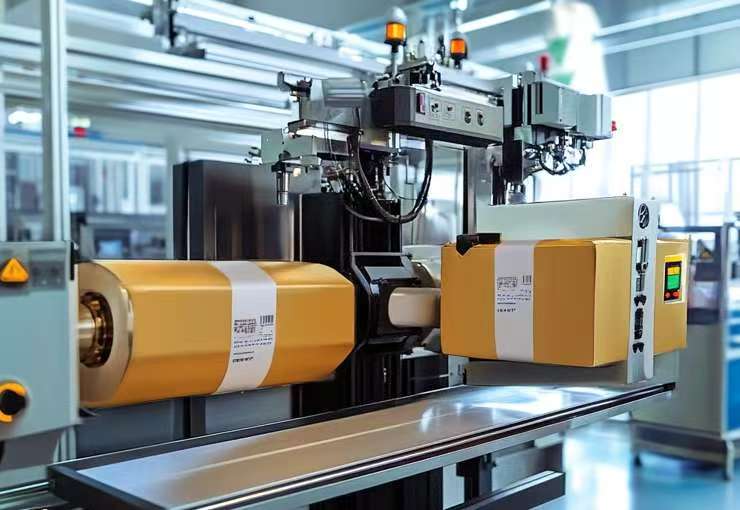
Servo motors for automated conveyor systems are useful when the conveyor must do more than move products at a steady speed. Typical tasks include repeated indexing, product registration, controlled acceleration, and synchronization with packaging or processing equipment.
However, not every conveyor needs a servo. Continuous transport and accumulation zones may be better served by other drive arrangements. The right choice depends on the required motion, load, accuracy, and control architecture.
This guide explains when servo control adds value and how to specify a motor-drive combination for the complete conveyor duty.
When Should a Conveyor Use a Servo Motor?
A servo system uses feedback to regulate motion. The controller generates commands, the drive controls motor current, and the motor produces torque. Feedback helps the system detect and correct deviations within its operating limits.
This can support demanding conveyor tasks, but it does not guarantee zero position error or compensate for every mechanical problem.
Indexing and product registration
An indexing conveyor advances by a defined distance, stops, and waits while another operation takes place. Examples include assembly, inspection, labeling, and packaging.
Servo control can provide repeatable motion profiles and adjustable index lengths. Where product spacing varies, sensors and registration functions may help align the movement with a detected product feature.
Motor position alone does not establish product position. A product may slide on the belt, and the belt may stretch or slip relative to the drive pulley. Accurate registration can require suitable fixtures, positive-drive belts, product sensors, or additional feedback.
Synchronization with other equipment
Electronic gearing and camming can coordinate a conveyor with another axis. Applications include matched-speed transfers, wrapping, and flying cutting operations.
The controller must support the required relationship between the axes. Robot tracking also requires compatible tracking functions and a defined conveyor reference; it does not happen automatically when a servo is installed.
Compare the available drive approaches
Conveyor task
Drive approach to evaluate
Continuous transport with adjustable speed
Geared motor with a suitable variable-speed drive
Zoned accumulation
Motorized rollers or decentralized conveyor drives
Moderate indexing duty
Stepper, closed-loop stepper, or servo, depending on requirements
Frequent indexing with demanding settling targets
Servo motor and compatible motion drive
Registered or synchronized processing
Coordinated motion system with suitable sensing and feedback
VFD-based systems can include vector control and encoder feedback. Compare actual capabilities rather than assuming that every induction-motor system is open loop.
How to Size Servo Motors for Automated Conveyor Systems
Define the conveyor mechanics and production cycle before selecting the motor.
Calculate load and pulley requirements
Gather the maximum product load, moving belt or chain mass, pulley dimensions, conveyor incline, friction, and transmission details.
For a belt conveyor without slip at the drive pulley:
For a reduction ratio defined as motor speed divided by pulley speed:
Motor speed = pulley speed × reduction ratio
The basic output-torque relationship is:
Pulley torque = tangential driving force × pulley radius
The driving-force calculation must include the relevant resistance, acceleration, and incline forces. Add pulley and roller rotational inertia where applicable. Use component manufacturers’ data for friction and efficiency rather than assuming a universal coefficient.
Check peak torque and continuous duty
Peak torque is needed during events such as acceleration or overcoming starting resistance. Continuous operation must remain within the motor’s thermal capability.
Check:
Acceleration and deceleration torque.
Torque at the required operating speed.
RMS torque over the complete production cycle.
Permitted peak duration and drive current.
Holding periods and low-speed operation.
Ambient temperature and mounting conditions.
Regenerative energy during deceleration or lowering.
RMS torque is a useful thermal screening calculation, but prolonged overloads also require checking the motor and drive’s operating limits.
Rapid deceleration transfers energy back into the drive system. Whether that energy is stored, dissipated through a resistor, shared on a DC bus, or returned to the supply depends on the equipment architecture.
Evaluate inertia and gearbox selection
Compare load inertia reflected to the motor shaft with rotor inertia. Do not compare conveyor payload mass directly with motor mass.
For a rotary load behind an ideal reduction gearbox, reflected load inertia decreases with the square of the reduction ratio. Include translating loads, rotating components, gearbox inertia, and motor inertia in the complete sizing model.
There is no universal inertia-ratio table that guarantees easy tuning, zero overshoot, or instability above a particular value. Acceptable ratios depend on stiffness, compliance, controller performance, and the required response.
A gearbox can increase available output torque and adjust motor speed. It also introduces losses, backlash, and additional mechanical limits. Direct drive may be suitable when the motor can satisfy the required torque and speed without reduction.
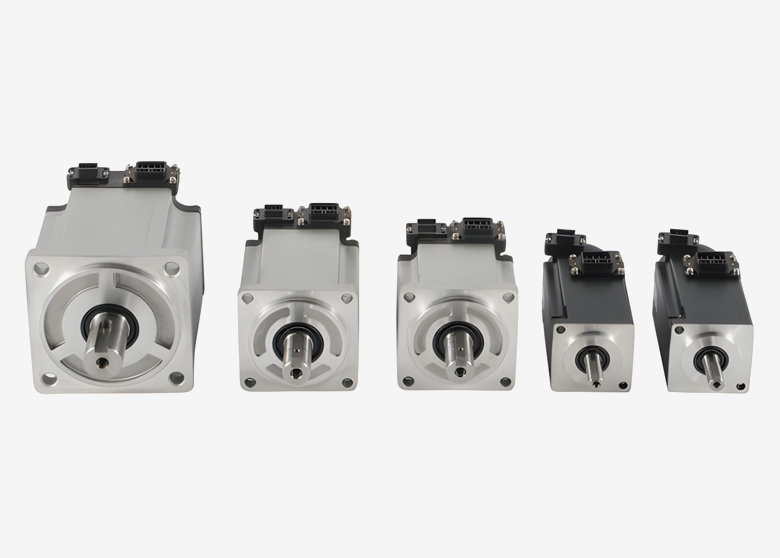
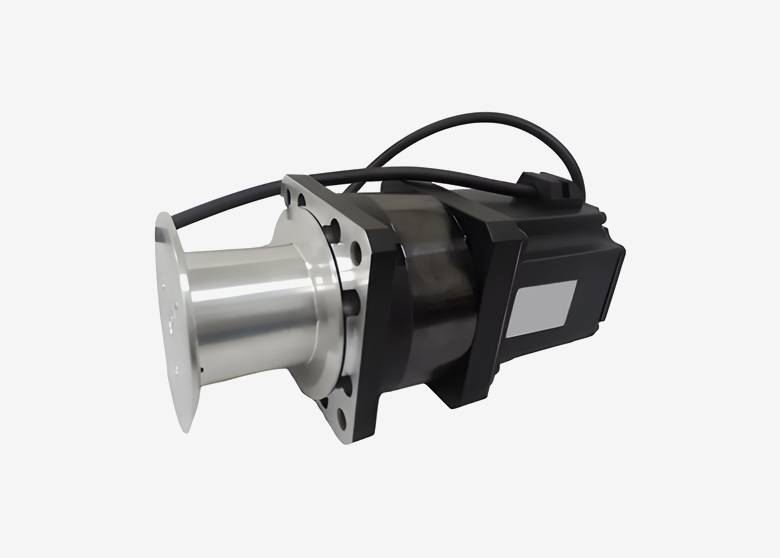
Tiger Motion’s standard servo motors and servo integrated gearmotors can be reviewed against these requirements. Confirm model-specific torque-speed curves, rotor inertia, output ratings, and compatible drives before selection.
Include payload variation
A conveyor may run empty, partially loaded, or at maximum capacity. Size for the relevant worst-case conditions and verify stable operation across the load range.
Avoid adding an arbitrary percentage to every calculation. Select margins based on uncertainty, wear, process variation, and the manufacturer’s guidance. Oversizing can increase cost, installation space, and rotor inertia without solving the actual problem.
Feedback, PLC Integration, and Motion Profiles
Select feedback for the recovery strategy
Incremental and absolute feedback can both be suitable, depending on the application.
Absolute feedback may simplify restart procedures, but single-turn and multi-turn behavior differ. Position retention also depends on the encoder technology and system configuration.
Neither encoder type detects every movement of the product. If products shift during a power interruption, the motor’s retained position does not establish where they are afterward.
Specify:
Motor-to-drive encoder compatibility.
Required resolution and accuracy.
Referencing and homing procedures.
Recovery after power loss or a jam.
Any belt, pulley, or product-position feedback.
A 24-bit position value represents 16,777,216 distinguishable positions over its defined range. That does not establish equivalent conveyor accuracy or eliminate velocity ripple.
Verify the actual motion interface
The servo drive, rather than the motor alone, normally provides the interface to the PLC or motion controller.
EtherCAT, PROFINET, and EtherNet/IP are possible network options, but the network name alone does not establish synchronized motion capability.
Check the supported motion functions, device profiles, update rates, configuration files, and controller compatibility. For example, ordinary network communication and coordinated motion over that network may require different capabilities.
Any required safety communication and drive safety functions must also be verified separately. A standard network connection does not establish a safety-rated system.
Choose profiles that suit the product
Higher acceleration can shorten travel time but increase belt vibration or cause products to slide, tip, or spill.
Where supported, jerk-limited profiles can reduce mechanical excitation. Evaluate total move-and-settle time and product behavior rather than maximizing acceleration alone.
For synchronized operations, test phase accuracy and response during line speed changes, normal stops, and restart sequences.
Confirm cable technology
Some servo systems use a hybrid cable carrying power and feedback in one cable assembly. Compatibility depends on the motor, drive, encoder interface, connectors, and cable specification.
For example, HIPERFACE DSL can use a dedicated feedback pair integrated into the motor cable. This does not mean feedback is universally transmitted over the motor phase conductors.
Confirm cable length, shielding, bend radius, and flex requirements for the selected system.
Environmental Protection and Conveyor Commissioning
Specify protection for the actual exposure
A dry enclosed conveyor and an exposed washdown conveyor have different requirements.
Provide details of dust, moisture, cleaning pressure, temperature, chemicals, and exposure duration. Where hygienic design matters, also assess surface finish, seals, connectors, drainage, and cleanability.
An IP rating describes specified ingress tests. It does not establish resistance to every cleaning chemical or suitability for every food-processing area. Do not assume that all food, beverage, or pharmaceutical conveyors require the same IP rating or housing alloy.
Assess inclined loads and pulley forces
A powered servo may hold a load within its continuous operating limits, but active holding torque is not a substitute for a suitable mechanical holding arrangement.
For inclined or gravity-loaded conveyors, assess behavior when power or torque is removed. Verify any brake or backstop requirements and the intended stopping sequence.
Also check allowable shaft loads. Belt tension can impose significant radial force, so the pulley may need independent bearing support rather than being mounted directly on the motor shaft.
Commission the complete conveyor
Inspect alignment, belt tracking, tension, gearbox mounting, and couplings before tuning. Follow manufacturer-supported procedures and avoid using filters to conceal binding or loose components.
Test the conveyor empty and under representative loads. Record:
Actual belt speed and index distance.
Product-position repeatability.
Move-and-settle time.
Motor and drive thermal behavior.
Synchronization with adjacent equipment.
Jam detection and recovery.
Stop, restart, and power-loss behavior.
Follow the selected equipment’s grounding, shielding, and cable-routing instructions. There is no single cable-separation distance suitable for every installation.
Evaluate the investment using measured cycle time, product damage, scrap, maintenance, and energy consumption. Servo control can improve a suitable application, but it does not guarantee a particular saving or payback period.
Frequently Asked Questions
1. Can a servo motor run continuously on a conveyor?
Yes, if the motor and drive meet the required continuous torque, speed, and thermal conditions. For steady transport, compare the cost and complexity with a suitable geared-motor system.
2. Does a servo guarantee accurate product stopping?
No. Motor feedback controls the motor’s position, while belt stretch, pulley slip, product movement, and mechanical play can affect the final product location. Additional sensing or positive positioning may be needed.
3. Does a conveyor servo motor need a gearbox?
Not always. A gearbox is useful when reduction helps meet torque, speed, or inertia requirements. Direct drive is possible when the complete motor and mechanical design satisfy the duty.
4. Is an absolute encoder necessary for conveyor indexing?
No. Choose feedback based on positioning and restart requirements. Absolute feedback may simplify recovery, but it does not automatically remove homing or product-location checks.
5. What information is needed for a conveyor motor quotation?
Provide conveyor type, payload range, pulley diameter, transmission ratio, belt speed, index distance, move time, dwell time, incline, supply voltage, controller model, and environmental conditions.
Discuss Your Conveyor Motion Requirements
Planning an indexing conveyor, synchronized transfer, or retrofit? Share your mechanical layout, load range, production cycle, control interface, and installation constraints with Tiger Motion.
Contact Tiger Motion to discuss motor options and request model-specific technical information. Include any gearbox, encoder, brake, and environmental requirements so the proposed configuration can be reviewed before ordering.